Action Hallucination in Generative Vision-Language-Action Models, Harold Soh★, Eugene Lim★, arXiv preprint
Links:
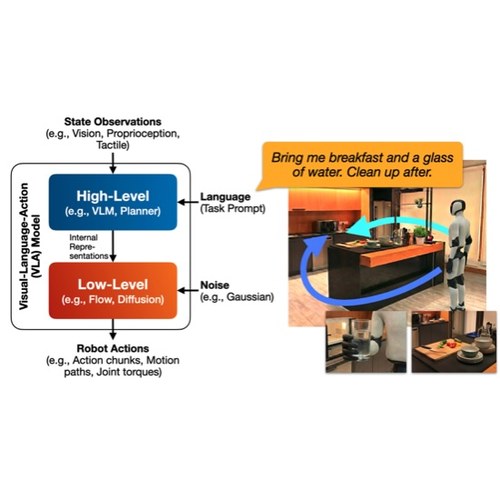
Robot Foundation Models, such as VLAs, promise end-to-end generative robot policies with broad generalization. Yet it remains unclear whether they fundamentally resolve the core problem of action generation in embodied settings, or overcome the long-standing challenges of robotics. We address this question by analyzing action hallucinations that violate physical constraints and their extension to plan-level failures.
Focusing on latent-variable generative policies, we show that hallucinations can arise from structural mismatches between feasible robot behavior and common model architectures. We study three such barriers—topological, precision, and horizon—and show how they impose unavoidable tradeoffs. Our analysis provides mechanistic explanations for reported empirical failures of generative robot policies and suggests principled directions for improving reliability and trustworthiness, without abandoning their expressive power.
Resources
You can find our paper here.
Citation
Please consider citing our paper if you build upon our results and ideas.
Harold Soh★, Eugene Lim★, “Action Hallucination in Generative Vision-Language-Action Models”, arXiv preprint
@misc{soh2026action, title={Action Hallucination in Generative Vision-Language-Action Models}, author={Soh, Harold and Lim, Eugene}, year={2026}, eprint={2602.06339}, archivePrefix={arXiv}, primaryClass={cs.RO}, url={https://arxiv.org/abs/2602.06339} }
Contact
If you have questions or comments, please contact Harold or Eugene.