Guided Streaming Stochastic Interpolant Policy, Puming Jiang★, Meiyi Wang★, Kelvin Lin★, Ce Hao★, Harold Soh★, Robotics: Science and Systems (R:SS)
Links:
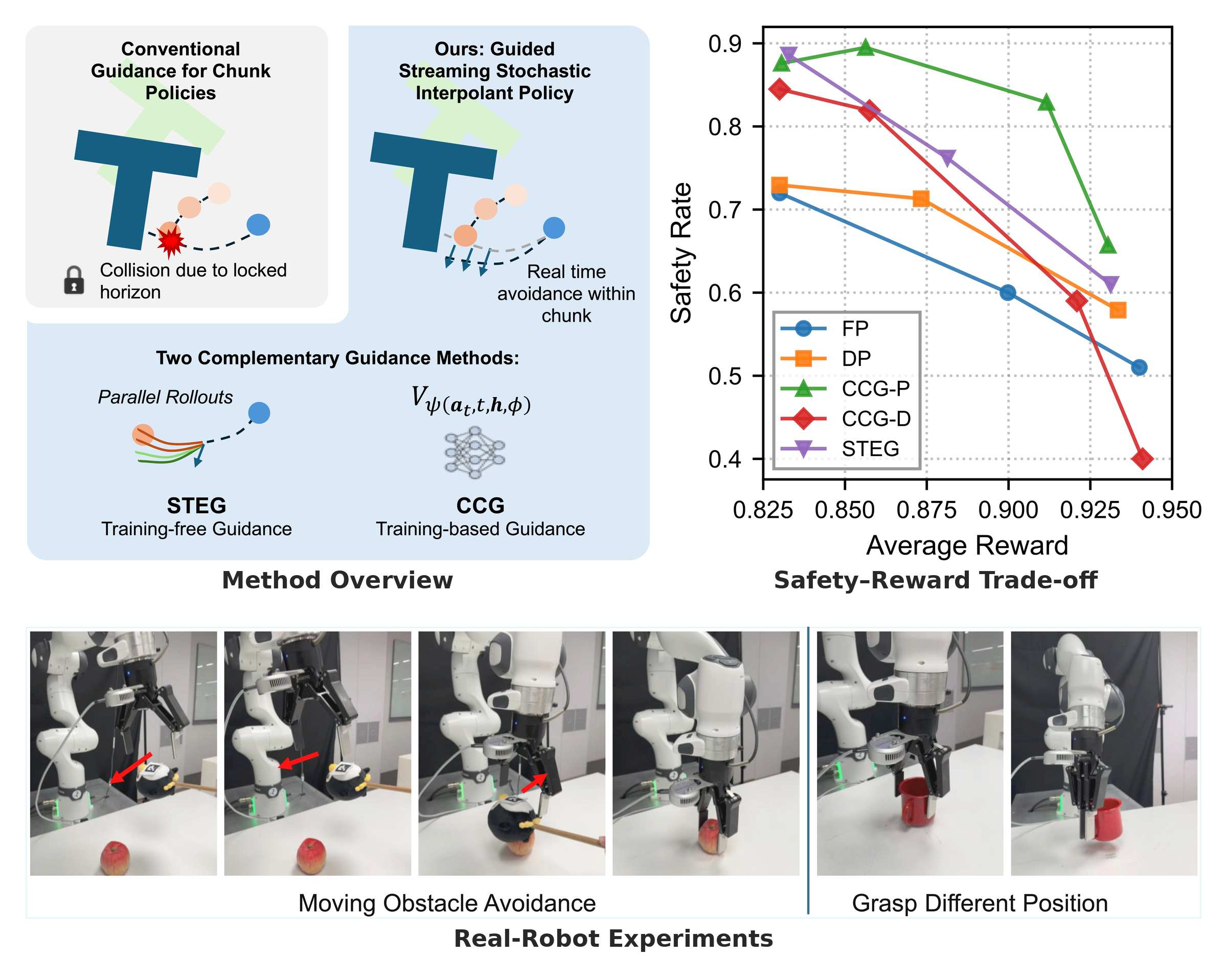
Inference-time guidance is essential for steering generative robot policies toward dynamic objectives without retraining, yet existing methods are largely confined to chunk-based architectures that exhibit high latency and lack the reactivity needed for test-time preference alignment or obstacle avoidance.
In this work, we formally derive the optimal guidance term for Stochastic Interpolants (SI) by analyzing the value function’s time evolution via the Backward Kolmogorov Equation, establishing a modified drift that theoretically guarantees sampling from a target distribution. We apply this framework to real-time control through the Streaming Stochastic Interpolant Policy (SSIP), which generalizes the deterministic Streaming Flow Policy (SFP). Unifying this guidance law with the streaming architecture enables fast and reactive control.
To support diverse deployment needs, we propose two complementary mechanisms: training-free Stochastic Trajectory Ensemble Guidance (STEG) that computes gradients on-the-fly for zero-shot adaptation, and training-based Conditional Critic Guidance (CCG) for amortized inference. Empirical evaluations demonstrate that our guided streaming approach significantly outperforms conventional chunk-based policies in reactivity and provides superior, physically valid guidance for dynamic, unstructured environments.
Resources
You can find our paper here.
Citation
Please consider citing our paper if you build upon our results and ideas.
Puming Jiang★, Meiyi Wang★, Kelvin Lin★, Ce Hao★, Harold Soh★, “Guided Streaming Stochastic Interpolant Policy”, Robotics: Science and Systems (R:SS)
@inproceedings{jiang2026guided, title={Guided Streaming Stochastic Interpolant Policy}, author={Jiang, Puming and Wang, Meiyi and Lin, Kelvin and Hao, Ce and Soh, Harold}, booktitle={Robotics: Science and Systems (R:SS)}, year={2026} }
Contact
If you have questions or comments, please contact Puming or Harold.